As an Amazon Associate this site earns from qualifying purchases.
Quick Picks: Cleaning Products for Steamer Descaling
| Product | Format | Best for | Link |
|---|---|---|---|
| Think Crucial Garment Steamer Descaler | 8 fl oz liquid | Owners of Jiffy, Conair or SALAV steamers who want a bottle they can dose repeatedly | Check Price on Amazon |
| SALAV Garment Steamer Descaling Solution Packets for Build-up Removal | 5 pre-measured packets | People who would rather not measure anything | Check Price on Amazon |
| Vacuum Steamer for Clothes, 3 in 1 Steaming & Ironing& Clean Dust Garment Steamer | Replacement steamer | Anyone whose current unit is beyond descaling | Check Price on Amazon |
Disclosure: We earn a small commission from qualifying Amazon purchases at no extra cost to you.
As an Amazon Associate we earn from qualifying purchases. This page contains affiliate links, and we may receive a commission if you buy through them — at no extra cost to you.
As an Amazon Associate, we earn from qualifying purchases.
Last Updated: September 2026
Here is the short answer. To clean a garment steamer, empty the tank, fill it with a 1:1 mix of distilled white vinegar and water (or a purpose-made descaling solution), run the unit until roughly half the tank has steamed out, let it sit 20 to 30 minutes, then flush with two or three tanks of plain water until the smell is gone. If steam output is still weak after that, the problem is almost always a partially blocked nozzle or a scaled heating element, not a dead motor.
That is the whole fix, and it takes about an hour of mostly waiting. The rest of this guide explains why buildup happens, how to do each step without damaging the unit, and which cleaning products are actually sold for this job.
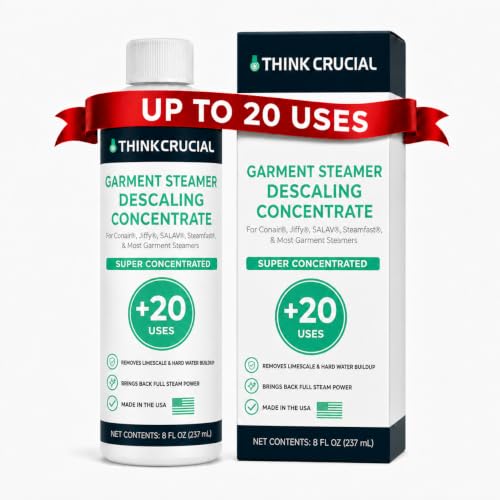
- UP TO 20+ USES PER BOTTLE — CONCENTRATED FORMULA — One 8 fl oz bottle provides up to 20+ garment steamer descaling cycles when using approximately 10 oz (300 mL) of cleaning water
- CONCENTRATED VALUE — USE ONLY WHAT YOUR STEAMER NEEDS — The concentrated formula lets you adjust the amount for your steamer instead of using a full single-use packet or bottle
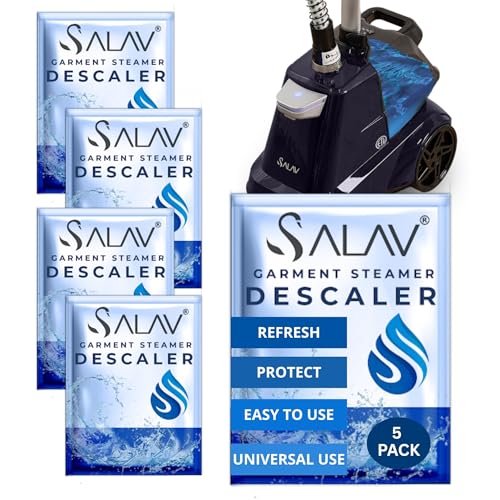
- POWERFUL DESCALING ACTION – Effectively dissolves tough limescale and mineral build-up inside garment steamers to restore full steam power and keep clothes looking smooth and
- SAFE & UNIVERSAL FORMULA – Non-corrosive, eco-friendly solution safe to use in all garment steamer brands and models, preventing costly damage and prolonging appliance life
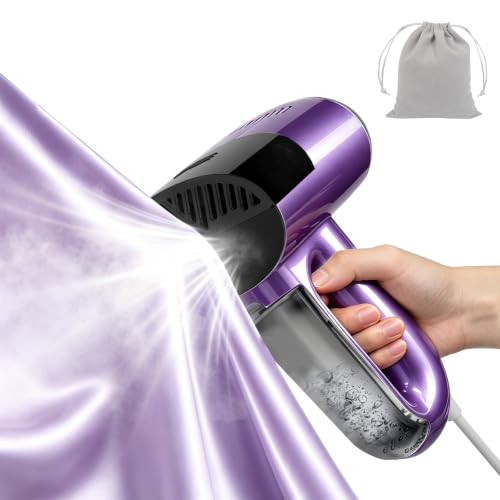
- REFRESH CLOTHES WITH LESS EFFORT – Smooth everyday wrinkles from shirts, dresses, blouses, pants and more without setting up an ironing board. A practical choice for busy
- FAST AND SIMPLE TO USE – Fill the water tank, 30 second quick heat up, then glide it gently over hanging garments. The handheld design makes it easy to refresh clothing at home or
The Problem: Hard Water Buildup in Your Steamer
A garment steamer boils water. That is its entire mechanism. Whatever was dissolved in that water — calcium, magnesium, iron — does not boil away with it. It stays behind, plates onto the heating element, and slowly narrows the internal steam path.
You notice it in a predictable order. First the steamer takes longer to produce steam. Then output gets thin and sputtery. Then it starts spitting white flecks or brownish water onto your clothes. Eventually you get a steamer not steaming at all, or a clogged steamer nozzle that hisses without delivering anything useful.
Here's the thing: none of that is a broken appliance. It is limescale doing exactly what limescale does. The manufacturer of one descaling product on the market, Think Crucial, sells it specifically as a limescale and mineral buildup remover for garment steamers, which tells you plainly how routine this failure mode is across the category. [S3]
Step-by-Step: How to Descale a Clothes Steamer with Vinegar
- Unplug it and let it cool completely. Not warm. Cool. You are about to pour liquid into a chamber that was recently at boiling point, and you will also be handling the nozzle.
- Empty the tank fully. Tip out every drop of the old water, including whatever is sitting in the reservoir corners. That water is the most mineral-concentrated liquid in the machine.
- Mix your solution. Equal parts distilled white vinegar and water is the standard household approach. If you prefer a commercial product, follow that product's own dilution instructions rather than guessing — the packet and bottle formats below exist precisely so you are not eyeballing acid concentration.
- Fill, reassemble, and heat. Fill the tank with the solution, seat it properly, and power the unit on in a sink or over a heat-safe basin.
- Steam out about half the tank. Aim the head away from you and away from any surface you care about. You want the hot acidic solution to actually travel through the hose, the internal channel, and out the nozzle holes — that whole path is where the scale lives.
- Power off and soak 20 to 30 minutes. This is the step people skip, and it is the step that does most of the work. Dissolving calcium carbonate is a chemical reaction, and reactions need contact time.
- Dump the remainder and flush. Refill with plain water, run it until empty, and repeat at least twice. Vinegar residue left in the boiler will transfer a sour smell to fabric on your next session.
- Wipe the nozzle plate. A soft cloth and, for stubborn deposits, a cotton swab. Do not use anything abrasive on the steam plate.
How to Fix a Clogged Steamer Nozzle
If a full descale did not restore output, the blockage is mechanical and sitting at the exit holes. Work through this in order:
- Check the hose position first. On hose-fed steamers, a hose that dips below the head traps condensate and chokes steam flow. Hold the hose straight and elevated and see whether output recovers before you assume a clog.
- Clear the holes cold. With the unit unplugged and cool, work a wooden toothpick or an unfolded paperclip gently into each nozzle hole. Wooden is safer — metal can scratch or widen the port.
- Soak the detachable head. If the head or a brush attachment detaches, drop it in undiluted white vinegar for 30 minutes, then rinse thoroughly and dry.
- Do a second descale cycle. Heavy scale sometimes needs two passes. If the second cycle produces visible flakes in the flushed water, keep going until the water runs clear.
- Inspect for a failed seal or pump. If none of the above moves the needle, you are past cleaning. A unit that heats but never builds pressure has a hardware fault, and the safer call is replacement rather than opening a sealed pressurized boiler yourself.
Tools and Products You'll Need
Most of this job needs nothing you do not already own: white vinegar, a sink, a soft cloth, a toothpick. The one thing worth buying is a dedicated descaler if you would rather not smell vinegar for two days or if your steamer's manual discourages household acids.
Recommended Products
Think Crucial Garment Steamer Descaler – Limescale & Mineral Buildup Remover – Compatible with Jiffy J-2000, J-4000, Conair & SALAV – 8 fl oz — Best for owners of Jiffy, Conair or SALAV steamers
The listing names its compatibility explicitly: Jiffy J-2000, Jiffy J-4000, Conair and SALAV garment steamers, in an 8 fl oz size. [S3] That matters more than it sounds. Jiffy J-2000 and J-4000 units are the workhorse upright steamers you find in tailoring shops and dry cleaners, and they run enough water through a boiler to scale up fast. A descaler that names those models is telling you it was formulated for that class of machine, not just for a countertop kettle.
The 8 fl oz volume is the practical detail to plan around. [S3] It is a bottle you dose from, not a single-use sachet, so how many cycles you get depends entirely on the dilution ratio printed on the label.
Pros
- Explicitly lists compatibility with Jiffy J-2000, J-4000, Conair and SALAV steamers [S3]
- Liquid format lets you scale the dose to a small handheld or a large upright boiler
- The listing does not publish the dilution ratio, so you cannot calculate cycles-per-bottle before you buy [S3]
- Think Crucial is a compatible-accessory brand, not the steamer manufacturer, so it carries no OEM endorsement from Jiffy or Conair
- At 8 fl oz, heavy-use commercial owners will likely be reordering [S3]
SALAV Garment Steamer Descaling Solution Packets for Build-up Removal, 5pc — Best for people who want pre-measured doses
This one comes from SALAV itself, sold as descaling solution packets for build-up removal in a 5-piece count. [S4] The pitch is dosing. Five packets, five descaling sessions, no measuring cup and no judgment call about how strong to make the mix.
Honestly, that convenience is the whole argument. If you descale quarterly, five packets is over a year of maintenance. If you are running a steamer daily on hard water, five sessions goes fast, and the liquid format above will stretch further.
Pros
- Pre-measured packets remove dilution guesswork entirely [S4]
- Comes from SALAV, the steamer manufacturer, rather than a third-party accessory brand [S4]
- The listing does not state which SALAV models it is validated for, so cross-brand owners are inferring compatibility [S4]
- Five packets is a hard ceiling — no ability to stretch a dose for a small handheld tank [S4]
- No published ingredient list on the listing, so anyone avoiding a specific acid cannot check [S4]
Vacuum Steamer for Clothes, 3 in 1 Steaming & Ironing& Clean Dust Garment Steamer — Best for replacing a steamer that descaling could not save
Sometimes the answer to weak steam is that the unit is finished. [S5] The 5500Pa figure is a vacuum-suction rating, not a steam-output rating — worth understanding before you buy it expecting boiler power.
The combination is unusual: it steams, it presses, and it pulls loose fibers and dust off fabric. For travel and quick wrinkle removal, a small tank is actually an advantage, because less water sitting in a chamber means less mineral deposit per session.
Pros
- Manufacturer rates the suction at 5500Pa, which is the only quantified performance figure published for this unit [S5]
- Combines steaming, ironing and dust removal in one handheld body [S5]
- 110V and travel-oriented, so it suits a suitcase rather than a laundry room [S5]
- The listing publishes no wattage, tank capacity or steam output rate, so you cannot compare it against an upright steamer on the numbers [S5]
- 110V-only means it is not usable abroad on 220V without a converter, which undercuts part of the travel argument [S5]
- No published brand heritage or warranty term on the listing [S5]
Tips for Best Results
Use distilled water going forward. This is the single highest-leverage habit change. Distilled water has essentially nothing dissolved in it, so there is nothing to leave behind. It converts descaling from a monthly chore into an annual one.
Empty the tank after every session. Water left standing in a warm plastic reservoir grows biofilm and concentrates minerals as it slowly evaporates.
Descale on a schedule, not on symptoms. By the time you notice weak steam, the deposit is already thick enough to need two cycles.
Store it dry and upright. Cap off, tank empty, hose uncoiled if the design allows it.
Common Mistakes to Avoid
- Skipping the soak. Running vinegar straight through without dwell time barely touches established scale.
- Using bleach or ammonia. Neither dissolves limescale, and both create genuinely hazardous fumes when heated.
- Under-flushing. Two or three plain-water tanks minimum. Vinegar residue will end up on a white shirt otherwise.
- Poking the nozzle with a hot unit plugged in. Steam burns are the most common injury this appliance causes.
- Descaling a unit whose manual forbids acids. Some sealed-boiler designs specify a proprietary solution only — read yours first.
- Assuming a dead steamer needs replacing. Most "broken" steamers are scaled steamers.
How We Research
This site does not perform product research. For this page, the three products above were identified through Amazon Creators API verified product records retrieved on 2026-09-05, and every specification quoted — the 8 fl oz descaler volume, the named Jiffy J-2000 and J-4000 compatibility, the 5-packet count, the 5500Pa suction rating and the 110V requirement — comes from those retailer listing records rather than from anything measured here. [S3] [S4] [S5]
Where a listing does not publish a figure, this guide says so rather than estimating. None of these three listings publishes a dilution ratio, a steam output rate or a warranty term, and those gaps are stated in each product's cons rather than papered over.
The descaling procedure itself is standard limescale chemistry and general appliance-care practice, not a product claim. For safety and recall information on any specific appliance, the CPSC is the authoritative U.S. source. [S1]
Final Verdict
Clean the steamer before you replace it. Nine times out of ten, weak steam is scale, and an hour with vinegar fixes it for free.
If you want a commercial product instead, the choice is genuinely about format rather than quality, because neither listing publishes enough chemistry to rank them. Buy the Think Crucial Garment Steamer Descaler if you own a Jiffy J-2000 or J-4000, a Conair or a SALAV, since those are the models its 8 fl oz listing names outright and a liquid lets you dose a big boiler properly. [S3] Buy the SALAV Garment Steamer Descaling Solution Packets if you want five pre-measured doses and no measuring at all — it is the manufacturer's own product for its own machines. [S4]
The Vacuum Steamer for Clothes is a different decision entirely. It is a replacement unit, and its only published performance number is 5500Pa of suction, which describes the dust-removal function rather than the steam. [S5] Consider it if your old steamer is genuinely dead and you want a travel-sized 110V handheld — not as an upgrade path from a working upright.
Related Resources
- Best garment steamers for home use
- Garment steamer vs clothes iron
- How to steam delicate fabrics safely
- Hard water and household appliances
Sources & Methodology
Nobody at this website steamed a shirt, timed a boiler, or descaled a single tank to write this page — there is no lab here and no test bench. What we did was pull the Amazon Creators API verified product records for these three ASINs on 2026-09-05 and read what the listings actually commit to in writing: an 8 fl oz descaler naming Jiffy J-2000, J-4000, Conair and SALAV compatibility; a 5-packet SALAV descaling set; and a 3-in-1 handheld rated by its maker at 5500Pa with a 110V requirement. [S3] [S4] [S5]
For a maintenance category like this, that level of evidence is enough to tell you which product fits your machine and which format suits your descaling frequency — but it cannot tell you how fast a solution dissolves scale, because none of these listings publishes that. Judge them on stated compatibility and dose format, and treat performance claims about dissolving speed with skepticism from any source that has not measured it.